Free Ebook Predictably Irrational: The Hidden Forces That Shape Our Decisions, by Dan Ariely
Investing the downtime by reviewing Predictably Irrational: The Hidden Forces That Shape Our Decisions, By Dan Ariely could provide such fantastic encounter even you are only sitting on your chair in the workplace or in your bed. It will certainly not curse your time. This Predictably Irrational: The Hidden Forces That Shape Our Decisions, By Dan Ariely will certainly direct you to have more precious time while taking rest. It is really enjoyable when at the midday, with a mug of coffee or tea as well as an e-book Predictably Irrational: The Hidden Forces That Shape Our Decisions, By Dan Ariely in your kitchen appliance or computer system screen. By appreciating the views around, below you can begin reviewing.
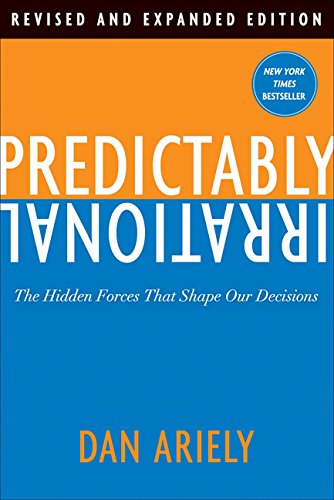
Predictably Irrational: The Hidden Forces That Shape Our Decisions, by Dan Ariely

Free Ebook Predictably Irrational: The Hidden Forces That Shape Our Decisions, by Dan Ariely
Predictably Irrational: The Hidden Forces That Shape Our Decisions, By Dan Ariely. A job may obligate you to consistently improve the knowledge as well as experience. When you have no adequate time to improve it straight, you could get the experience as well as knowledge from reviewing guide. As everybody recognizes, publication Predictably Irrational: The Hidden Forces That Shape Our Decisions, By Dan Ariely is very popular as the home window to open the world. It implies that reading publication Predictably Irrational: The Hidden Forces That Shape Our Decisions, By Dan Ariely will provide you a new way to discover every little thing that you require. As guide that we will certainly offer right here, Predictably Irrational: The Hidden Forces That Shape Our Decisions, By Dan Ariely
As known, lots of people say that publications are the home windows for the world. It doesn't indicate that buying e-book Predictably Irrational: The Hidden Forces That Shape Our Decisions, By Dan Ariely will suggest that you can buy this globe. Just for joke! Checking out an e-book Predictably Irrational: The Hidden Forces That Shape Our Decisions, By Dan Ariely will certainly opened an individual to believe far better, to keep smile, to amuse themselves, as well as to urge the understanding. Every e-book additionally has their unique to influence the reader. Have you known why you read this Predictably Irrational: The Hidden Forces That Shape Our Decisions, By Dan Ariely for?
Well, still confused of exactly how to get this publication Predictably Irrational: The Hidden Forces That Shape Our Decisions, By Dan Ariely here without going outside? Merely link your computer system or kitchen appliance to the web and also begin downloading and install Predictably Irrational: The Hidden Forces That Shape Our Decisions, By Dan Ariely Where? This web page will reveal you the link web page to download Predictably Irrational: The Hidden Forces That Shape Our Decisions, By Dan Ariely You never ever fret, your preferred e-book will certainly be sooner yours now. It will certainly be much easier to appreciate reviewing Predictably Irrational: The Hidden Forces That Shape Our Decisions, By Dan Ariely by online or obtaining the soft file on your device. It will certainly despite that you are and also exactly what you are. This publication Predictably Irrational: The Hidden Forces That Shape Our Decisions, By Dan Ariely is written for public as well as you are one of them which can enjoy reading of this e-book Predictably Irrational: The Hidden Forces That Shape Our Decisions, By Dan Ariely
Spending the leisure by reviewing Predictably Irrational: The Hidden Forces That Shape Our Decisions, By Dan Ariely can supply such great encounter even you are just sitting on your chair in the workplace or in your bed. It will not curse your time. This Predictably Irrational: The Hidden Forces That Shape Our Decisions, By Dan Ariely will certainly direct you to have more priceless time while taking rest. It is very satisfying when at the midday, with a cup of coffee or tea and a book Predictably Irrational: The Hidden Forces That Shape Our Decisions, By Dan Ariely in your gizmo or computer system screen. By delighting in the views around, here you could begin reading.
"A marvelous book… thought provoking and highly entertaining."
—Jerome Groopman, New York Times bestselling author of How Doctors Think
"Ariely not only gives us a great read; he also makes us much wiser."
—George Akerlof, 2001 Nobel Laureate in Economics
"Revolutionary."
—New York Times Book Review
Why do our headaches persist after we take a one-cent aspirin but disappear when we take a fifty-cent aspirin? Why do we splurge on a lavish meal but cut coupons to save twenty-five cents on a can of soup?
When it comes to making decisions in our lives, we think we're making smart, rational choices. But are we?
In this newly revised and expanded edition of the groundbreaking�New York Times�bestseller, Dan Ariely refutes the common assumption that we behave in fundamentally rational ways. From drinking coffee to losing weight, from buying a car to choosing a romantic partner, we consistently overpay, underestimate, and procrastinate. Yet these misguided behaviors are neither random nor senseless. They're systematic and predictable—making us predictably irrational.
- Sales Rank: #1056305 in Books
- Published on: 2010-05-11
- Released on: 2010-05-11
- Format: International Edition
- Original language: English
- Number of items: 1
- Dimensions: 6.75" h x .92" w x 4.19" l, 1.10 pounds
- Binding: Mass Market Paperback
- 400 pages
From Publishers Weekly
Irrational behavior is a part of human nature, but as MIT professor Ariely has discovered in 20 years of researching behavioral economics, people tend to behave irrationally in a predictable fashion. Drawing on psychology and economics, behavioral economics can show us why cautious people make poor decisions about sex when aroused, why patients get greater relief from a more expensive drug over its cheaper counterpart and why honest people may steal office supplies or communal food, but not money. According to Ariely, our understanding of economics, now based on the assumption of a rational subject, should, in fact, be based on our systematic, unsurprising irrationality. Ariely argues that greater understanding of previously ignored or misunderstood forces (emotions, relativity and social norms) that influence our economic behavior brings a variety of opportunities for reexamining individual motivation and consumer choice, as well as economic and educational policy. Ariely's intelligent, exuberant style and thought-provoking arguments make for a fascinating, eye-opening read. (Feb.)
Copyright � Reed Business Information, a division of Reed Elsevier Inc. All rights reserved.
Review
“This is a wonderful, eye-opening book. Deep, readable, and providing refreshing evidence that there are domains and situations in which material incentives work in unexpected ways. We humans are humans, with qualities that can be destroyed by the introduction of economic gains. A must read!” (Nassim Nicholas Taleb, New York Times bestselling author of The Black Swan: The Impact of the Highly Improbable)
“Sly and lucid. . . . Predictably Irrational is a far more revolutionary book than its unthreatening manner lets on.” (New York Times Book Review)
“Surprisingly entertaining. . . . Easy to read. . . . Ariely’s book makes economics and the strange happenings of the human mind fun.” (USA Today)
“A fascinating romp through the science of decision-making that unmasks the ways that emotions, social norms, expectations, and context lead us astray.” (Time magazine)
“In creative ways, author Dan Ariely puts rationality to the test. . . . New experiments and optimistic ideas tumble out of him, like water from a fountain.” (Boston Globe)
“An entertaining tour of the many ways people act against their best interests, drawing on Ariely’s own ingeniously designed experiments. . . . Personal and accessible.” (BusinessWeek)
“Ariely’s book addresses some weighty issues . . . with an unexpected dash of humor.” (Entertainment Weekly)
“Inventive. . . . An accessible account. . . . Ariely is a more than capable storyteller . . . If only more researchers could write like this, the world would be a better place.” (Financial Times)
“Ariely’s intelligent, exuberant style and thought-provoking arguments make for a fascinating, eye-opening read.” (Publishers Weekly)
“A taxonomy of financial folly.” (The New Yorker)
“A marvelous book that is both thought provoking and highly entertaining, ranging from the power of placebos to the pleasures of Pepsi. Ariely unmasks the subtle but powerful tricks that our minds play on us, and shows us how we can prevent being fooled.” (Jerome Groopman, New York Times bestselling author of How Doctors Think)
“Dan Ariely is a genius at understanding human behavior: no economist does a better job of uncovering and explaining the hidden reasons for the weird ways we act, in the marketplace and out. PREDICTABLY IRRATIONAL will reshape the way you see the world, and yourself, for good.” (James Surowiecki, author of The Wisdom of Crowds)
“PREDICTABLY IRRATIONAL is a charmer-filled with clever experiments, engaging ideas, and delightful anecdotes. Dan Ariely is a wise and amusing guide to the foibles, errors, and bloopers of everyday decision-making.” (Daniel Gilbert, Professor of Psychology, Harvard University and author of Stumbling on Happiness)
“The most difficult part of investing is managing your emotions. Dan explains why that is so challenging for all of us, and how recognizing your built-in biases can help you avoid common mistakes.” (Charles Schwab, Chairman and CEO, The Charles Schwab Corporation)
“PREDICTABLY IRRATIONAL is wildly original. It shows why—much more often than we usually care to admit—humans make foolish, and sometimes disastrous, mistakes. Ariely not only gives us a great read; he also makes us much wiser.” (George Akerlof, Nobel Laureate in Economics, 2001 Koshland Professor of Economics, University of California at Berkeley)
“Dan Ariely’s ingenious experiments explore deeply how our economic behavior is influenced by irrational forces and social norms. In a charmingly informal style that makes it accessible to a wide audience, PREDICTABLY IRRATIONAL provides a standing criticism to the explanatory power of rational egotistic choice.” (Kenneth Arrow, Nobel Prize in Economics 1972, Professor of Economics Stanford University)
“A delightfully brilliant guide to our irrationality—and how to overcome it—in the marketplace and everyplace.” (Geoffrey Moore, author of Crossing the Chasm and Dealing with Darwin)
“After reading this book, you will understand the decisions you make in an entirely new way.” (Nicholas Negroponte, founder of MIT's Media Lab and founder and chairman of the One Laptop per Child non-profit association)
“PREDICTABLY IRRATIONAL is a scientific but imminently readable and decidedly insightful look into why we do what we do every day...and why, even though we ‘know better,’ we may never change.” (Wenda Harris Millard, President, Media, Martha Stewart Living Omnimedia)
“Predictably Irrational is an important book. Full of valuable and entertaining insights that will make an impact on your business, professional, and personal life.” (Jack M Greenberg, Chairman, Western Union Company, Retired Chairman and CEO, McDonald's Corporation)
“Predictably Irrational is clever, playful,humorous, hard hitting, insightful, and consistently fun and exciting to read.” (Paul Slovic, Founder and President, Decision Research)
“Freakonomics held that people respond to incentives, perhaps in undesirable ways, but always rationally. Dan Ariely shows you how people are deeply irrational, and predictably so.” (Chip Heath, Co-Author, Made to Stick, Professor, Stanford Graduate School of Business)
From the Back Cover
Why do our headaches persist after we take a one-cent aspirin but disappear when we take a fifty-cent aspirin?
Why do we splurge on a lavish meal but cut coupons to save twenty-five cents on a can of soup?
When it comes to making decisions in our lives, we think we're making smart, rational choices. But are we?
In this newly revised and expanded edition of the groundbreaking New York Times bestseller, Dan Ariely refutes the common assumption that we behave in fundamentally rational ways. From drinking coffee to losing weight, from buying a car to choosing a romantic partner, we consistently overpay, underestimate, and procrastinate. Yet these misguided behaviors are neither random nor senseless. They're systematic and predictable—making us predictably irrational.
Most helpful customer reviews
10 of 10 people found the following review helpful.
The True Complexity of Human Minds
By Kevin L. Nenstiel
Let’s start with this simple premise: human beings don’t behave according to conventional economic models. Whether the capitalist supply-demand arc, or the Marxist labor dialectic, human behavior steadfastly resists slotting into categories experts consider “rational.” We often ignore our best interests, make choices which render us poorer and less happy, and cannot value our options reliably. Yet we do this in completely consistent, reliable ways. Why?
Israeli-American professor Dan Ariely holds doctorates in psychology and business. Through appointments at MIT, Stanford, and Duke, he has helped mold the still-young discipline of Behavioral Economics, a research field which examines human choices without preconceived models. His discoveries shed light on human reasoning, and why what seems unreasonable actually serves very consistent purposes. This book provides an interesting thumbnail introduction to a discipline still new and somewhat dangerous.
Consider how people will treasure something that costs more, assuming it’s more effective, better quality, or whatever. Anyone who’s ever slipped box wine into a posh bottle already knows this. Higher prices, subconsciously, translate into better products. Yet the arc shifts when the price hits zero. We’ll chose a measurably inferior but free product rather than pay one thin dime. This seems counter-rational, but actually has well-rooted human behavioral causes.
Late in the book, Ariely writes: “Behavioral economists… believe that people are susceptible to irrelevant influences from their immediate environment…, irrelevant emotions, shortsightedness, and other forms of irrationality.” Though this makes a decent definition of his field, it sounds harsh and judgemental, which this book mostly isn’t. Unlike standard economics, which literally assumes humans are money-driven reason machines, Ariely sees human behavior as driven by forces we cannot see.
However, these invisible forces, unlike the fabled “invisible hand,” actually have measurable traits. For instance, consider volunteer activities. If Habitat For Humanity needed to pay its workers the going rate for construction labor, it couldn’t afford to build homes for the destitute. Why will people people donate freely time and labor they’d charge dearly for if money became involved? Because society is bound together by forces economics cannot value monetarily.
Likewise, given complete impunity, most people will cheat slightly to pursue their own advantage. But most people will cheat far less than they possibly could. What forces keep chiseling to a reasonable minimum? Apparently we have complex neurological structures that let us monitor ourselves, asking whether we’re upholding our own basic judgments. Our brains literally stop healthy people from swindling others. Honesty isn’t merely a morality, it’s a neural imperative.
Ariely demonstrates we could prevent even limited cheating with simple steps. Honesty oaths and honor pledges work effectively, as do simple reminders of moral codes like the Ten Commandments. We can also minimize cheating by keeping consequences close-by and visible, as by transacting business in cash, not credit. The bankers who imploded the economy shortly after this book appeared probably wreaked havoc because, psychologically, they were handling Monopoly money.
Through-lines develop across Ariely’s chapters, without his need to notice. We don’t cheat profligately, and moral nudges halt even minimal cheating, because social standards are based upon trust. Economies where trust runs high, like America, thrive because we’ll keep money flowing, trusting few people will deceive. Economies with limited trust, like Iran, struggle with minimal growth. But it takes remarkably little to undermine trust, and when it’s gone, it’s gone.
These examples aren’t thought experiments or mathematical models. Ariely draws conclusions based on experiments in the laboratory and the field. Some are only possible now because of advancing technology—in one example, a colleague replicates the famous Pepsi Challenge with subjects strapped into an fMRI machine. Others involve simple field tests anyone could replicate by offering free chocolate or beer. But they’re all based on real-life trials and empirical data.
In consequence, these discoveries challenge both the traditional Left and Right in American politics. Because people aren’t theory machines, prefab theories cannot encompass our choices: we’re driven neither by profit, as neoclassical economics insists, nor by the class-based identity Marxism demands. Our motives defy standard categorization, threaten anyone who’d predict or control our choices, and expand regular citizens’ views of themselves and their choices.
Ariely’s experiments make humans more, not less, complex. They demonstrate we’re ore powerful and sophisticated than even we ourselves realize. But our complexity also makes us vulnerable to forces we cannot see externally. Behavioral Economics makes humans both more and less reasonable, both more and less predictable. And in so doing, arguably, it makes us more human, overthrowing the theories which bind us.
7 of 7 people found the following review helpful.
Read this book if you really want to figure out why people wind up doing things the way they do
By Studying llfe in New York
Not sure why I wanted to read this book other than the fact that Dan has some hilarious videos out there, that are equally intriguing in their implications. This book felt very much like the Dan from the videos. I feel like I learned a lot about humanity namely that we can observe people making the same mistakes repeatedly, but we can interject the lessons we glean to change outcomes for the better- like improve people's honesty or make better financial decisions. Wish more people would read this book and heed his advice- perhaps we all would be a lot happier with society as a whole- and with ourselves! It should be required reading for parents, school administrators and students before graduating (high school and college). It definitely turns traditional economics on its head.
5 of 5 people found the following review helpful.
Good for the Anecdotes
By Allan M. Lees
Among the various books available that cover the topic of human behavior, Predictably Irrational is among the top ten (interested readers should also read Sway by Rom Brafman). It's not quite an economics book (for a much better analysis of the many failings of neoclassical economics, read Debunking Economics by Keen) and it's not quite a behavioral psychology book (read Sway) so it falls somewhere in the middle - and therein lies its main weakness.
There are some very interesting anecdotes (for example, do you know why we think black pearls are valuable when originally no one wanted to buy them at any price?) and these are where most of the book's value lies.
The principal weakness comes from Ariely's conclusions based on the work he's carried out. He acknowledges that we humans are "irrational" compared to the straw man of the "rational optimizer" beloved of neoclassical economic theory, but while some of his examples are interesting he fails to see the entire picture. Thus whereas Keen shows that the neoclassical model is computationally impossible, Ariely merely shows that we have different decision-making processes in two distinct contexts: interpersonal and financial. This is valid, but Ariely then goes on to show that he hasn't really explored the interpersonal context with any degree of rigor.
A couple of examples will illustrate what I mean. In the first example Ariely talks about how companies strive to create a "social exchange" in the workplace because people generally work harder and more diligently in social exchange settings than in compensation-based settings. We can think of how we might keep on struggling to get a friend's piano up the stairs of a narrow apartment building long after we'd have given up if we were simply being paid $10 per hour by a stranger to perform the same task. So Ariely notes that companies try to exploit our social side in order to get more work out of us (he doesn't look at the ethics of this attempt, or even at its many infeasibilities). Then he suggests that in order to reinforce the social dynamic and avoid corrupting it with the financial dynamic (because it's not possible to combine the two) companies should not give bonuses but instead should send employees off on a paid-for vacation. The problem, of course, is that most employees don't want to be placed in a parent-child relationship. Most employees think of themselves as independent adults. Saying "here's a vacation we've arranged for you" violates an employee's independence. Worse still it assumes the employee's plans for their free time are irrelevant (the cost of leaving one's home, family, and friends for the duration of the enforced vacation are apparently zero where the company is concerned...). Obviously this recommendation would be disastrous under real-world conditions and one wonders how Ariely failed to think through his proposal.
A second example of this failure to think things through comes with Ariely's analysis of cap-and-trade. Rightly he points out that when you set a price on something (in this case pollution) then people may elect to pay more in order to get more. Just as we might only take a single candy from a tray being passed around the group but might buy ten if the candies are being sold, so too might companies pollute less if pollution were a "social good" rather than a priced good. With cap-and-trade companies might simply elect to pay more in order to feel free to pollute more. So Ariely proposes making pollution a "social good." But again a moment's thought shows this to be absurd. Not only do we have far too many examples of companies being quite happy to pollute when it's a cost-free exercise, Ariely's own book shows that executives will ignore social factors when their focus in on financial rewards. As executives are almost exclusively motivated by fat financial rewards, the notion that they would take social norms into account when deciding whether or not (or how much) to pollute is like saying that investment bankers would put the needs of their clients and the financial system in general ahead of their own desire for the $100 million bonus they get from pushing CDOs onto unsuspecting dupes.
So in the end the book is worth reading for its anecdotal value but not for Ariely's own conclusions or policy suggestions. He's not-quite an economist and not-quite a behavioral psychologist and ultimately that means he's not-quite useful as a guide to policy formulation on either the micro or the macro scales.
Predictably Irrational: The Hidden Forces That Shape Our Decisions, by Dan Ariely PDF
Predictably Irrational: The Hidden Forces That Shape Our Decisions, by Dan Ariely EPub
Predictably Irrational: The Hidden Forces That Shape Our Decisions, by Dan Ariely Doc
Predictably Irrational: The Hidden Forces That Shape Our Decisions, by Dan Ariely iBooks
Predictably Irrational: The Hidden Forces That Shape Our Decisions, by Dan Ariely rtf
Predictably Irrational: The Hidden Forces That Shape Our Decisions, by Dan Ariely Mobipocket
Predictably Irrational: The Hidden Forces That Shape Our Decisions, by Dan Ariely Kindle

No comments:
Post a Comment